Search “ephesus sda nyc” and you get service times, a Yelp page, and a couple of short institutional blurbs. What you don’t get is the actual story: a Black Adventist congregation that organized in the 1920s, split from its own denomination in a fight that made national religious news, birthed the Boys Choir of Harlem, survived a devastating fire, and still worships inside a Victorian Gothic landmark on West 123rd Street. Here is that story, laid out as a timeline you can actually follow.
Ephesus SDA NYC at a Glance
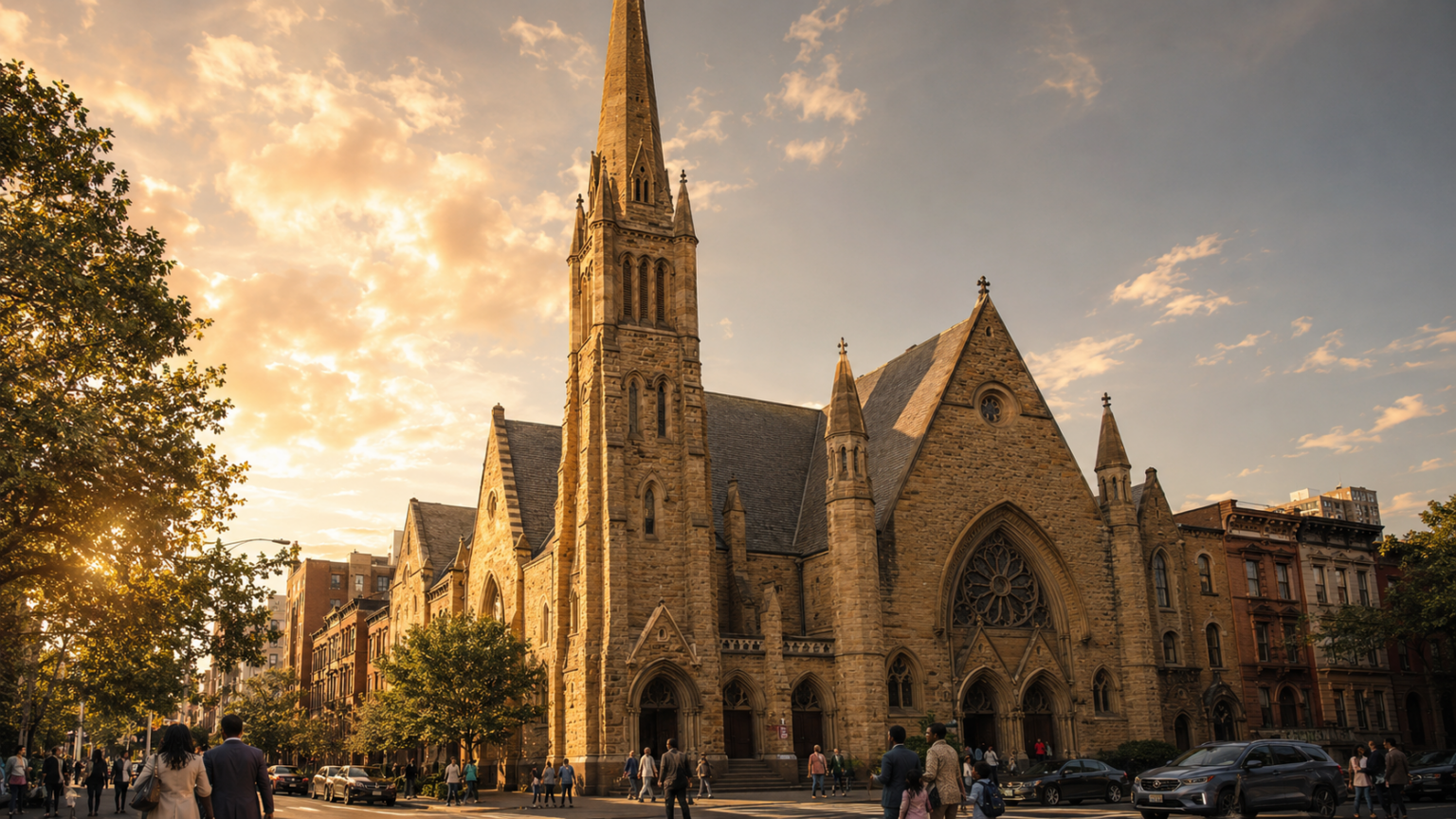
The Ephesus Seventh-day Adventist Church sits at 101 West 123rd Street in Harlem, just off Lenox Avenue and a block from Mount Morris (now Marcus Garvey) Park. It is one of the oldest continuously active Black Adventist congregations in New York City, and its sanctuary is a contributing structure in the Mount Morris Park Historic District, designated by the city in 1971.
- Address: 101 W 123rd St, Harlem, New York, NY
- Denomination: Seventh-day Adventist (Northeastern Conference)
- Congregation organized: 1924 (as Harlem No. 2); renamed “Ephesus” in 1930
- Building completed: 1887, originally a Dutch Reformed church
- Architect: John Rochester Thomas
- Style: Victorian Gothic Revival, sandstone facade
- Landmark status: Mount Morris Park Historic District (1971)
- Cultural claim to fame: founding home of the Boys Choir of Harlem
One quick clarification, because the autocomplete queries make it obvious people get tangled up here: this Ephesus has nothing to do with the ancient city of Ephesus in modern-day Turkey, the one tied to the Seven Wonders and the Book of Ephesians. The Harlem congregation simply took its name from Ephesus, the first of the seven churches named in the Book of Revelation. Same word, entirely different place.
Origins and Historical Timeline of Ephesus SDA New York
The building came first, the congregation second — by about four decades. That gap is the part most pages skip, and it’s what makes the history legible.
- 1885–1887: The structure is built for a Harlem Reformed (Dutch Collegiate) congregation, designed by John Rochester Thomas, a prolific church architect who left his mark on more than 150 New York houses of worship.
- 1903: James K. Humphrey, a Jamaican-born former Baptist minister, begins Adventist evangelistic work among Harlem’s growing Black population, laying the groundwork for Black Adventism in the city.
- 1924: The Harlem No. 2 Seventh-day Adventist company is organized with roughly 130 members, meeting in rented space such as Carlton Hall.
- 1929–1930: The original Dutch Reformed congregation moves on, and the Adventists lease the 123rd Street building. On June 18, 1930, the congregation marches from Carlton Hall into its new home — a defining community moment.
- 1930: The church is renamed Ephesus, and almost immediately becomes the center of a denominational storm.
- 1939–1945: Ephesus buys the building outright, grows past 1,000 members, retires the mortgage, and installs a new pipe organ.
- 1968: Choirmaster Walter Turnbull starts a youth choir at Ephesus that becomes the Boys Choir of Harlem.
- 1969: A major fire guts the sanctuary; the congregation relocates temporarily to nearby St. Andrew’s Episcopal Church.
- 1971: The block falls within the newly designated Mount Morris Park Historic District.
- 1977–1983: An eight-year, roughly $2.3 million reconstruction restores the building; the congregation returns and again pays off its debt.
- 2006: A steeple restoration, reported at around $1.6 million, is completed.
The Utopia Park schism
Here’s the chapter no ranking page tells you. James K. Humphrey wasn’t just an evangelist; he had a vision to build “Utopia Park,” a Black-owned community development in the New York area. Denominational leaders balked at both the plan and Humphrey’s growing independence, and in 1930 his ministerial credentials were revoked. His Harlem congregation backed him almost unanimously — the reported vote was 595 to 5 — and the group broke away to form the United Sabbath-Day Adventists. It remains one of the more significant, and least documented, episodes in Harlem’s religious history, and it’s the reason the Ephesus name marks both a continuing Adventist congregation and a moment of rupture.
Notable People and Events
A church this old is really a story about the people who moved through it.
- James K. Humphrey — the founding evangelist of Black Adventism in Harlem, and later the lightning rod whose Utopia Park ambitions ended in expulsion and a new denomination.
- Matthew C. Strachan and the pastors who followed in the 1930s and ’40s — the leaders who steadied Ephesus after the split and drove it to four-figure membership.
- Walter Turnbull — the tenor and educator whose small Ephesus choir grew into the internationally touring Boys Choir of Harlem, which later became an independent institution and a fixture of Harlem’s cultural identity.
- John Rochester Thomas — the architect whose 1880s Gothic Revival design still defines the streetscape, decades after most of his other churches were demolished.
The 1930 march from Carlton Hall deserves its own line. Moving an entire congregation on foot into a new building was part logistics, part public statement — a young Black church announcing that it intended to stay.
Role in Harlem History
Ephesus took root during the Great Migration, when Harlem was becoming what contemporaries called the “Black capital of America.” Church-building was central to that transformation. Congregations were mutual-aid societies, employment networks, schools, and political staging grounds as much as they were places of worship, and Ephesus fit that mold — leaning into education, health ministries, and youth programs, all three of which the Adventist tradition emphasizes.
Geographically, it belongs to the same Harlem that produced the townhouses of 116th Street and the storied blocks running up from Lenox Avenue. It sits a short distance from other landmarks that anchor the neighborhood’s story, including the Audubon Ballroom uptown. If you’re mapping Harlem’s institutions — the ones tied to figures from Anthony “Fat Tony” Salerno to the entertainers and organizers who defined the district — Ephesus is one of the durable religious pillars that outlasted most of its neighbors.
What Remains Today
The Ephesus SDA church in New York is still an active congregation, holding worship on Saturdays as Adventist practice requires. The sandstone facade, the restored steeple, and the carved corbels survive from the 19th-century building, and the church has long prized a bell reportedly cast in Amsterdam in the 1700s — a physical link to the structure’s Dutch Reformed origins.
Because it’s a contributing building in the Mount Morris Park Historic District, the church is a natural stop on any walking tour of the neighborhood’s Gilded Age architecture. If you want to see it, you can attend a service or simply admire the exterior from the sidewalk — but treat it as what it is: a working house of worship, not a museum. That means quiet cameras, respectful timing, and checking current service hours before you go, since they change.
The short version: Ephesus SDA NYC is where a 19th-century Dutch Reformed sanctuary became the home of a 20th-century Black Adventist congregation, a religious controversy, and a world-famous choir — all on one Harlem block.
FAQs
What is Ephesus Church in Harlem?
Ephesus is the Ephesus Seventh-day Adventist Church, a historic Black Adventist congregation at 101 West 123rd Street in Harlem. It organized in 1924, took the name Ephesus in 1930, and worships in an 1887 Victorian Gothic building that is part of the Mount Morris Park Historic District.
Where is Ephesus SDA New York located?
The Ephesus SDA church in New York is at 101 West 123rd Street, in Harlem, just off Lenox Avenue and near Marcus Garvey (Mount Morris) Park. Services are held on Saturday, the Adventist Sabbath; confirm current times before visiting.
Is Ephesus SDA Church in Harlem the same as the ancient city of Ephesus?
No. The Harlem church has no connection to the ancient city of Ephesus in modern-day Turkey or the Seven Wonders. It was named after Ephesus, the first of the seven churches mentioned in the Book of Revelation.
What denomination is the New York Ephesus Seventh-day Adventist Church?
It is a Seventh-day Adventist congregation, affiliated with the denomination’s Northeastern Conference. Adventists worship on Saturday, the seventh-day Sabbath, and emphasize health, education, and community ministry.
Who founded Ephesus SDA Church in New York?
Its roots trace to evangelist James K. Humphrey, who began Adventist work in Harlem around 1903. The Harlem No. 2 congregation was organized in 1924 and renamed Ephesus in 1930. Humphrey later split from the denomination in the 1930 Utopia Park controversy.
What happened to Ephesus SDA Church after the 1969 fire?
A fire gutted the sanctuary in 1969, and the congregation worshiped temporarily at St. Andrew’s Episcopal Church. An eight-year reconstruction costing about $2.3 million was completed between 1977 and 1983, and the steeple was later restored in 2006.
What is the Boys Choir of Harlem’s connection to Ephesus SDA Church?
The Boys Choir of Harlem began as a youth choir founded by Walter Turnbull at Ephesus SDA Church in 1968. It later became an independent, internationally recognized cultural institution, but its origin was inside the church.