
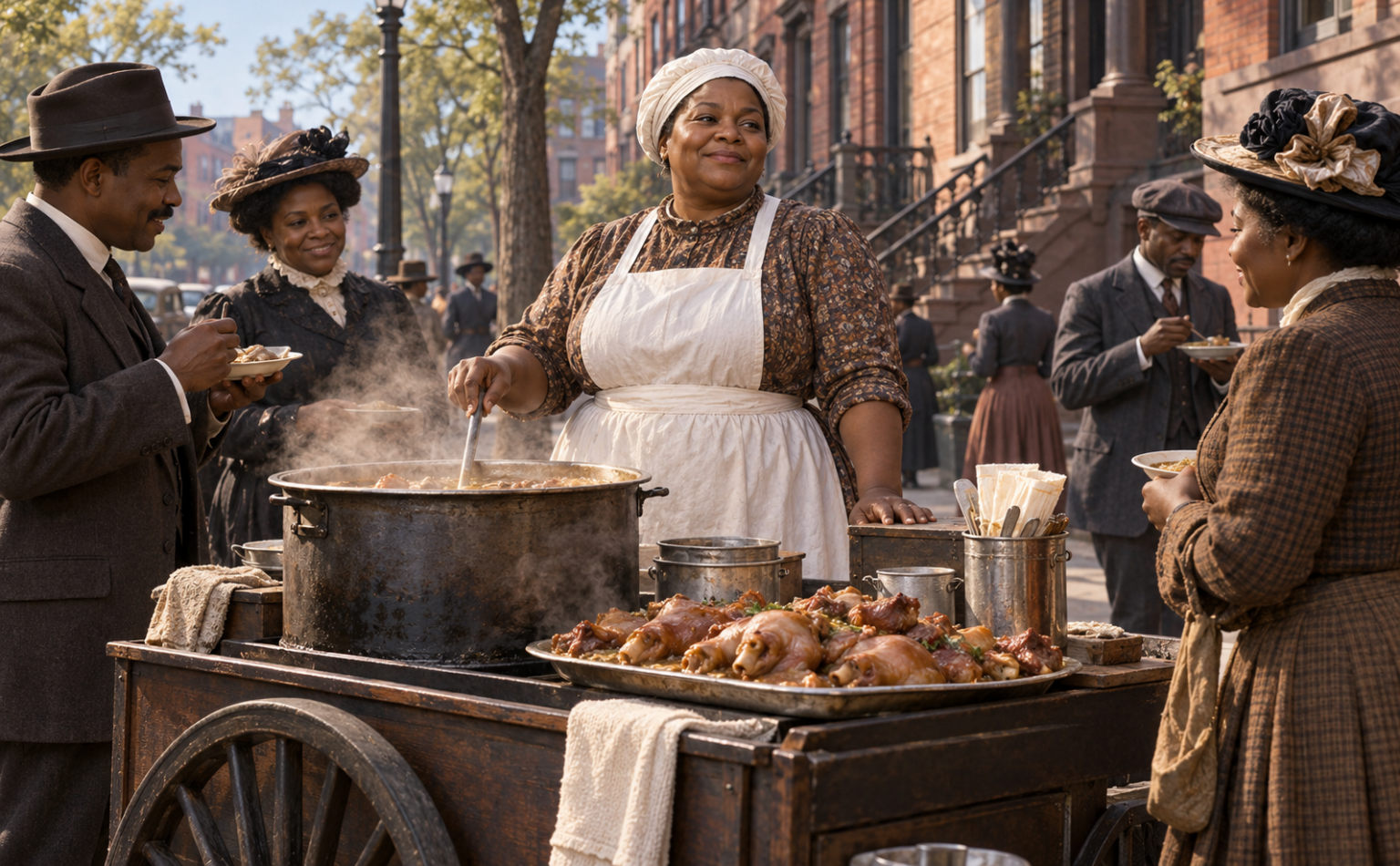
Pigfoot Mary was a real person. Her name was Lillian Harris Dean, and she turned a few dollars and a cart of boiled pigs’ feet into a property business in Harlem in the early 1900s. Most of what ranks for her name online is either a ticket page for a children’s play or a short tribute. This page puts the biography, the numbers and the gaps in the record together. Where something isn’t documented, we say so.
Who Was Pigfoot Mary?
Pigfoot Mary was Lillian Harris Dean (c. 1870–1929), a Southern-born street-food vendor who became one of the better-known Black property owners in Harlem. She started selling food in Manhattan around 1901, built a following for her pigs’ feet, moved her business to Harlem, married newsstand owner John Dean and put her profits into apartment buildings.
- The person: Lillian Harris Dean, the real entrepreneur.
- The play: Pigfoot Mary’s Harlem Renaissance, a youth theater piece by Daniel Carlton that is loosely based on her.
- The film character: Loretta Devine played a fictionalized “Pigfoot Mary” in the 1997 gangster film Hoodlum.
Standard references put her death in California in 1929. None of the sources we checked document the cause of death.
Lillian Harris Dean: The Founder Background
From the Mississippi Delta to Manhattan
Dean was born around 1870 in the Mississippi Delta. Like hundreds of thousands of Black Southerners at the turn of the century, she went north for work and arrived in New York around 1901. The usual account says she first worked as a domestic and saved a few dollars.
The 1901 cart on 60th Street
With those savings she put together a makeshift setup, usually described as a baby carriage fitted with a boiler. She sold hot food on West 60th Street in what was then the San Juan Hill neighborhood. Her best-selling item was pigs’ feet, a cheap Southern staple that recent migrants missed and could not find easily in Manhattan. That one product became her nickname and her brand.
The move behind it is easy to miss. She found where her customers already were, sold them something familiar they couldn’t get elsewhere, and kept her overhead close to zero. In retellings, the business model in those first years is that simple.
Harlem and John Dean
When Black New York moved uptown in the 1910s, she followed her customers to Harlem and set up near Lenox Avenue and 135th Street, which was then the heart of the neighborhood. Accounts say she worked next to a newsstand run by John Dean and later married him. A food cart next to a newsstand on a busy corner is a smart pairing: both sell to the same commuters, and each brings traffic to the other.
How thin the record is
Be honest about the sourcing. Most of what we know goes back to a short passage, about two paragraphs, in James Weldon Johnson’s 1930 history Black Manhattan, plus later newspaper features and landmark-research summaries. She left no known letters, business ledgers or interviews. Many “facts” repeated online are retellings of retellings, so treat exact dollar figures and addresses with caution.
Pigfoot Mary Timeline and Key Numbers
| Year | Event | Confidence |
|---|---|---|
| c. 1870 | Born in the Mississippi Delta | Widely cited; exact date unknown |
| 1901 | Arrives in New York and starts selling food from a cart on West 60th Street | Consistent across sources |
| 1910s | Moves her business to Harlem near Lenox Ave and 135th St | Consistent; exact year varies |
| 1910s | Marries newsstand owner John Dean | Consistent; date not documented |
| 1910s–1920s | Buys a five-story apartment house on Seventh Avenue and later more Harlem property | Reported; cross street and price vary by source |
| 1920s | Fortune described as “several hundred thousand dollars” | Estimate from NYC landmark research, not an audited figure |
| 1929 | Dies in California | Cited by standard references; cause undocumented |
The numbers that matter
- Starting capital: a few dollars, according to the traditional account. No receipt survives.
- Core product: one item, pigs’ feet, which also became her name.
- Flagship asset: a five-story apartment building on Seventh Avenue. The Amsterdam News places it at 135th Street, while other accounts give a nearby cross street.
- Net worth: “several hundred thousand dollars” at her peak, according to city landmark research. Treat this as an estimate. Specific figures you’ll see online can’t be traced to a primary record.
Pigfoot Mary’s Harlem and NYC Impact
Feeding the Great Migration
Harlem’s Black population grew sharply between 1910 and 1930. Many newcomers lived in crowded rentals with limited kitchens and worked long hours. Street vendors like Dean filled that gap with cheap, familiar food on corners people already walked past. She belongs to the same street-level economy that later produced the nightlife at places like Smalls Paradise and the open-air trade you still see at Shabazz Market.
Black property ownership in the 1920s
Her bigger legacy is real estate. In 1920s New York, few Black residents owned the buildings they lived in, and most Harlem property was held by white landlords and institutions. A food vendor who became a landlord was unusual enough that Johnson wrote about her. Regina Abraham’s book describes her as one of relatively few African Americans who owned New York City real estate in that decade.
How she’s remembered
She now appears in food-history projects, including the Museum of Food and Drink’s Legacy Quilt Project, alongside other early Black food entrepreneurs. Harlem has no plaque or mural for her that we could confirm. Given how much of the neighborhood’s history is told on its murals, that is a noticeable gap.
Pigfoot Mary in Books, on Stage and in Film
The book
Regina Abraham’s Pig Foot Mary: The Saga of Lillian Harris (2011) is the main book-length treatment. Read it as a narrative account, not an archival biography, because the underlying record is thin.
Pigfoot Mary’s Harlem Renaissance (the play)
Daniel Carlton’s play began as Pig Foot Mary Says Goodbye to the Harlem Renaissance, which grew out of a Metropolitan Playhouse commission. It now tours as the youth and school version Pigfoot Mary’s Harlem Renaissance. Venues such as NJPAC and the Paramount have booked it with teacher guides for the 2026–27 season. It is an introduction to the Harlem Renaissance, with Mary as the guide character, and it is not a documentary. Check each venue’s page for dates.
The Pigfoot Mary movie character in Hoodlum
In Hoodlum (1997), Loretta Devine plays Pigfoot Mary, a restaurant owner tied to Laurence Fishburne’s Bumpy Johnson. That version is fiction: the film is set in the 1930s, after the real Dean had died. Don’t use the movie as a source for her life.
Netflix, documentaries and the recipe
- Netflix or documentary: we found no confirmed Netflix title or standalone documentary about Lillian Harris Dean as of October 2026.
- Recipe: no authentic Pigfoot Mary recipe has survived. Recipes sold under her name are modern interpretations. Typical Southern pigs’ feet are simmered for hours with vinegar, onion, pepper and spices. That’s a fair guess at what she sold, but it is still a guess.
What Pigfoot Mary’s Story Means for Readers
Put the legend aside and her story is still a useful playbook for anyone starting a small food or retail business in Harlem today.
- Start small to test demand. She tested demand with almost no capital before she committed to anything bigger. Today that means a market stall, a pop-up or a licensed cart, not a lease.
- Be known for one thing. “Pigfoot Mary” is a brand built on one product. If customers can’t name the thing you do best, you don’t have a brand yet.
- Choose locations that bring you foot traffic. A spot next to a newsstand on a busy corner was her version of sharing a counter with a coffee shop. Look for neighbors who sell to the same customers you do.
- Turn income into assets. Her wealth came from property, not from pigs’ feet. The cart paid for the building, and the building is what lasted.
- Keep records. Her story is thin because she left almost no paper trail. Keep your books, permits and deeds organized, both for your business and for the history.
One modern reality check: street vending in New York is still hard to get into. Mobile food vending permits were capped for decades, and a 2021 city law only started phasing in new licenses a few hundred a year. Look into permits before you buy equipment.
For more on the people who shaped this neighborhood, read our profiles of Jules Bledsoe and the history of Smalls Paradise.
FAQs
Was Pigfoot Mary a real person?
Yes. Pigfoot Mary was Lillian Harris Dean (c. 1870–1929), a Mississippi-born food vendor who started selling in Manhattan around 1901 and went on to own Harlem real estate. The play and the character in the film Hoodlum are fictionalized versions of her.
How did Pigfoot Mary die?
Standard references say she died in California in 1929. None of the sources we checked document the cause of death, so be skeptical of any page that states one without citing a record.
How much money did Pigfoot Mary make?
No ledgers survive. New York City landmark research says she built a fortune of several hundred thousand dollars, mostly through Harlem real estate, including a five-story apartment building on Seventh Avenue. Treat that as an estimate, not an audited figure.
What did Pigfoot Mary sell and where was her stand?
She was best known for boiled pigs’ feet, a Southern staple. She started on West 60th Street around 1901 and later moved to Harlem near Lenox Avenue and 135th Street, next to John Dean’s newsstand.
Who played Pigfoot Mary in Hoodlum, and is there a documentary or Netflix show?
Loretta Devine played a fictionalized Pigfoot Mary in the 1997 film Hoodlum. The movie is set in the 1930s, after the real Dean had died. As of October 2026 we found no confirmed Netflix title or standalone documentary about her.
Is there a Pigfoot Mary book or original recipe?
Regina Abraham’s 2011 book Pig Foot Mary: The Saga of Lillian Harris is the main book-length account. No authentic recipe of hers survives. Recipes using her name are modern interpretations of traditional Southern pigs’ feet.


