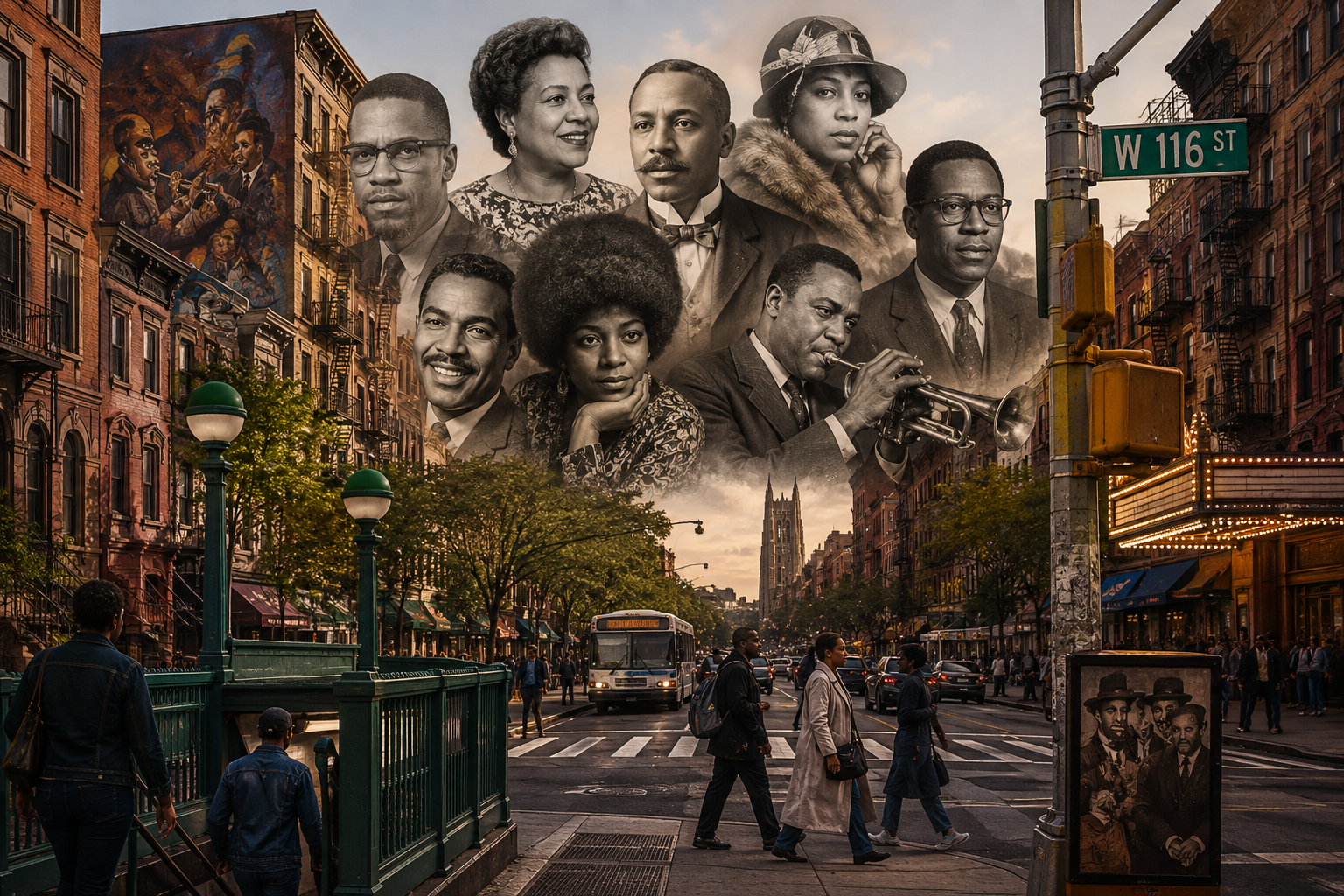
Ask a New Yorker about “116th Street” and the answer depends entirely on where they board it. Walk it east from the Hudson and you cross three different cities in under two miles: Columbia University’s Morningside Heights, Central Harlem’s Lenox Avenue corridor and its West African “Little Senegal,” and East Harlem — El Barrio — where the street becomes the main artery of Puerto Rican New York. Most reference pages pick one of those stories. This is all three, with a timeline, the people who shaped it, and what’s still standing today.
New York 116th Street at a Glance
If you searched “116 st manhattan” or “116th st new york ny” for a quick answer, start here.
- Where it runs: Riverside Drive on the Hudson east to the FDR Drive and the East River — roughly 1.7 miles across upper Manhattan.
- Why it feels different: At 100 feet wide, 116th is one of a handful of extra-wide crosstown streets designated in the 1811 street grid, versus the standard 60-foot side street.
- Neighborhoods crossed (west to east): Morningside Heights, Central Harlem, East Harlem / Spanish Harlem (El Barrio).
- Subway service: the 1 at Columbia University (Broadway), the B/C at Frederick Douglass Boulevard, the 2/3 at Lenox Avenue (Malcolm X Boulevard), and the 6 at Lexington Avenue. The Second Avenue Q line runs nearby on the far East Side.
So is it Harlem or Spanish Harlem? Both. The Central Harlem stretch near Lenox is what people mean by “116th street harlem,” while “east 116th street new york ny” points to El Barrio east of Fifth Avenue. One street, two neighborhood identities, plus the university edge to the west.
Origins and Historical Timeline
The reason “116th harlem” feels like a boulevard rather than a side street traces back to a single planning decision.
| Year | What happened |
|---|---|
| 1811 | The Commissioners’ Plan lays out Manhattan’s grid and marks 116th as one of about fifteen 100-foot-wide crosstown streets meant to carry traffic and light between the rivers. |
| 1890s | The far West End develops as apartment living reaches uptown; a curved redesign near Riverside Drive is tied to grand buildings like The Colosseum and The Paterno. |
| 1890s–1900s | Columbia University relocates to Morningside Heights, on land that had earlier held the Bloomingdale Asylum, remaking the street’s western anchor. |
| 1910s–1930s | The Great Migration transforms Central Harlem into the capital of Black America; the Harlem Renaissance blooms just blocks north and south. |
| 1940s–1950s | Puerto Rican migration reshapes East Harlem, cementing East 116th Street as the commercial spine of El Barrio. |
| Late 20th c. | West African immigrants establish “Little Senegal” along 116th west of St. Nicholas Avenue; the 116th Street Festival launches in El Barrio (1985). |
That 100-foot width is not trivia. It’s why the street reads as a boundary and a stage — wide enough for markets, processions and festivals that narrower blocks could never hold.
Notable People and Events
When people ask what famous figures are tied to “116th street harlem ny,” one name leads: Malcolm X. He led Nation of Islam Mosque No. 7 near Lenox Avenue and 116th, in a former casino building. The site — today the Malcolm Shabazz Mosque, beside the Malcolm Shabazz Harlem Market — remains the street’s most powerful civil-rights landmark. Malcolm’s later years and 1965 assassination unfolded just north at the ballroom we cover in our piece on the Audubon Ballroom location.
The corridor sits inside the dense fabric of 20th-century Black Harlem. Walk a few blocks and you’re near the townhouses of Strivers’ Row, the Black social elite of the Boule, and the racket-and-nightlife Harlem of the Bumpy Johnson era. It’s the same Harlem that produced the actors, musicians and organizers we profile elsewhere — including performers like Helen Martin and figures with deep uptown roots such as Billy Dee Williams.
East of Fifth Avenue, the political story is Italian and then Puerto Rican: Fiorello La Guardia rose from these blocks, and Congressman Vito Marcantonio built a fierce working-class base here. The literary record runs alongside it — Ann Petry set her 1946 novel The Street in this Harlem, and the neighborhood recurs across mid-century New York fiction.
Role in Harlem History
116th Street’s real significance is that it works as both a seam and a bridge. To the west of Fifth Avenue it belongs to Central Harlem’s Black cultural corridor; to the east it becomes the heart of El Barrio.
Nothing captures the eastern identity like La Marqueta, the market that grew under the Park Avenue railroad viaduct at 116th. For decades it was where generations of Puerto Rican and Latino families shopped, and it remains a symbol of “new york park avenue 116th street” as a Latino landmark rather than a Midtown address.
To the west, Little Senegal (Le Petit Sénégal) took shape from the 1980s onward as Senegalese and other West African immigrants opened restaurants, tailors, braiding salons and mosques around 116th near St. Nicholas Avenue — a newer layer of the same immigrant story that has always defined the street. The result is a single roadway that holds African, African American and Latino New York end to end.
What Remains Today
The living street is easy to read segment by segment:
- Morningside Heights (west): Columbia’s campus edge and College Walk, plus the curved gateway of The Colosseum and The Paterno overlooking Riverside Park.
- Central Harlem (middle): Little Senegal’s restaurants and shops, and the Malcolm Shabazz Mosque and market at Lenox — the cultural core for “116th st harlem” searches.
- East Harlem (east): the El Barrio commercial strip, the enduring La Marqueta site, and the big-box retail of East River Plaza near the FDR.
The clearest “then and now” thread is the 116th Street Festival, held each summer since 1985. It began as a celebration of Puerto Rican heritage and now draws huge crowds for music, food and vendors — a modern extension of the market culture that has run along this street for a century. To explore it honestly, just ride it end to end: take the 1 to Columbia, transfer to the 2/3 at Lenox for Little Senegal and the mosque, then the 6 to Lexington for El Barrio. No tour required.
Frequently Asked Questions
What is 116th Street in New York known for?
116th Street is known for crossing three distinct worlds in under two miles: Columbia University’s Morningside Heights to the west, Central Harlem’s Lenox Avenue corridor and “Little Senegal” in the middle, and East Harlem — El Barrio — to the east, home to La Marqueta and the annual 116th Street Festival. It’s also tied to Malcolm X, who led Mosque No. 7 near Lenox and 116th.
Is 116th Street in Harlem or Spanish Harlem?
Both. West of Fifth Avenue, near Lenox Avenue, 116th runs through Central Harlem. East of Fifth Avenue it becomes East 116th Street, the commercial spine of Spanish Harlem (El Barrio). The same street carries two neighborhood identities, plus Columbia’s Morningside Heights at its western end.
What subway trains stop at 116th Street?
Several. The 1 stops at 116th–Columbia University on Broadway, the B and C at 116th–Frederick Douglass Boulevard, the 2 and 3 at 116th–Lenox Avenue (Malcolm X Boulevard), and the 6 at 116th–Lexington Avenue. The Second Avenue Q line also runs nearby on the far East Side.
Why is 116th Street wider than most Manhattan streets?
The 1811 Commissioners’ Plan that created Manhattan’s grid designated about fifteen crosstown streets — including 116th — as 100 feet wide, versus the standard 60-foot side street, to move traffic, air and light between the rivers. That extra width is why 116th feels like a boulevard and can host markets and festivals.
What is the 116th Street Festival?
The 116th Street Festival is an annual summer street festival in East Harlem celebrating Puerto Rican and Latino culture, held along East 116th Street since 1985. It features live music, food vendors and huge crowds, and is one of New York’s largest Latino cultural celebrations.
How are New York City streets numbered?
In Manhattan’s grid, numbered streets run east–west and rise as you go north, while numbered avenues run north–south. Fifth Avenue splits addresses into East and West sides, which is why the same roadway is “116th Street” in Central Harlem and “East 116th Street” in El Barrio.