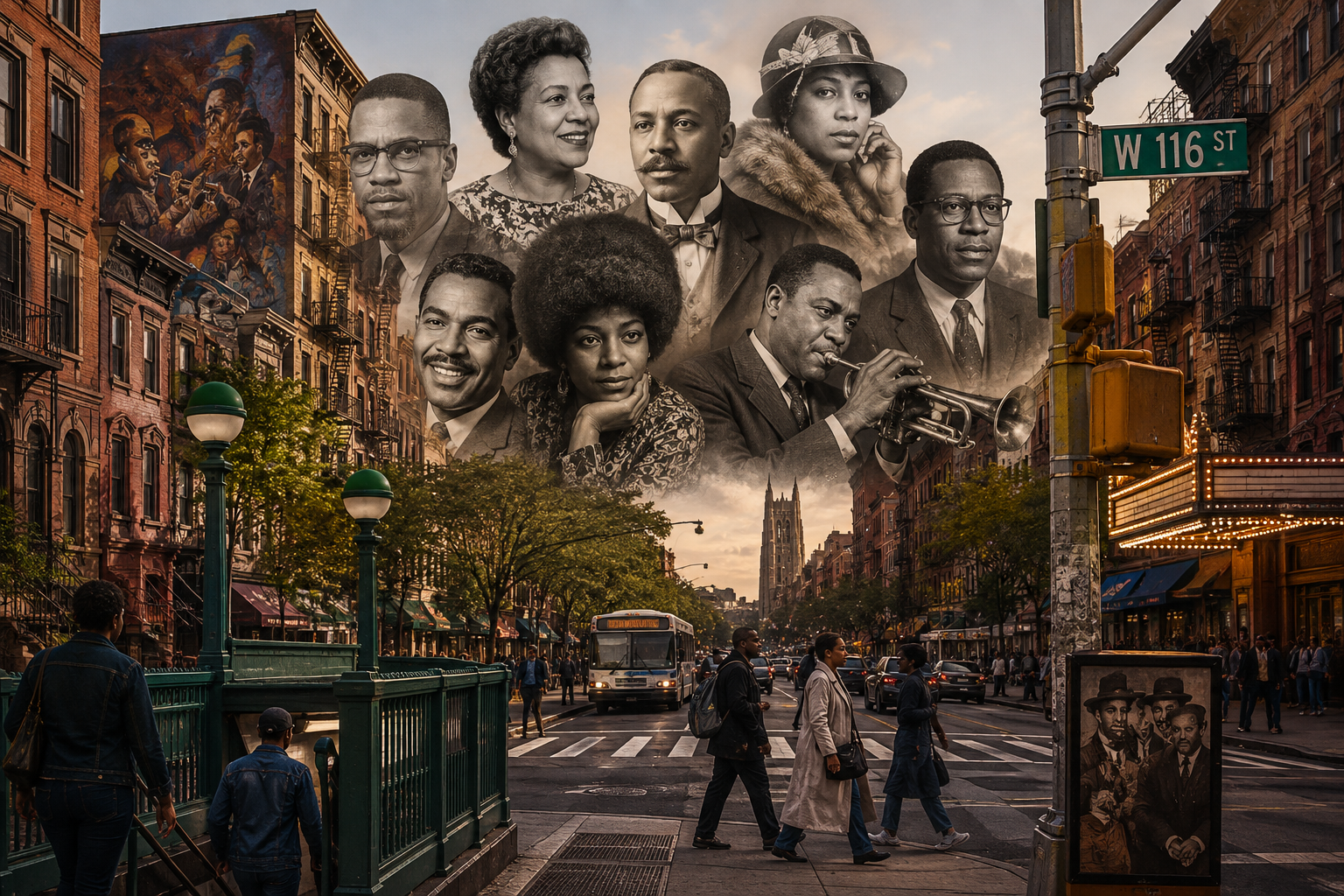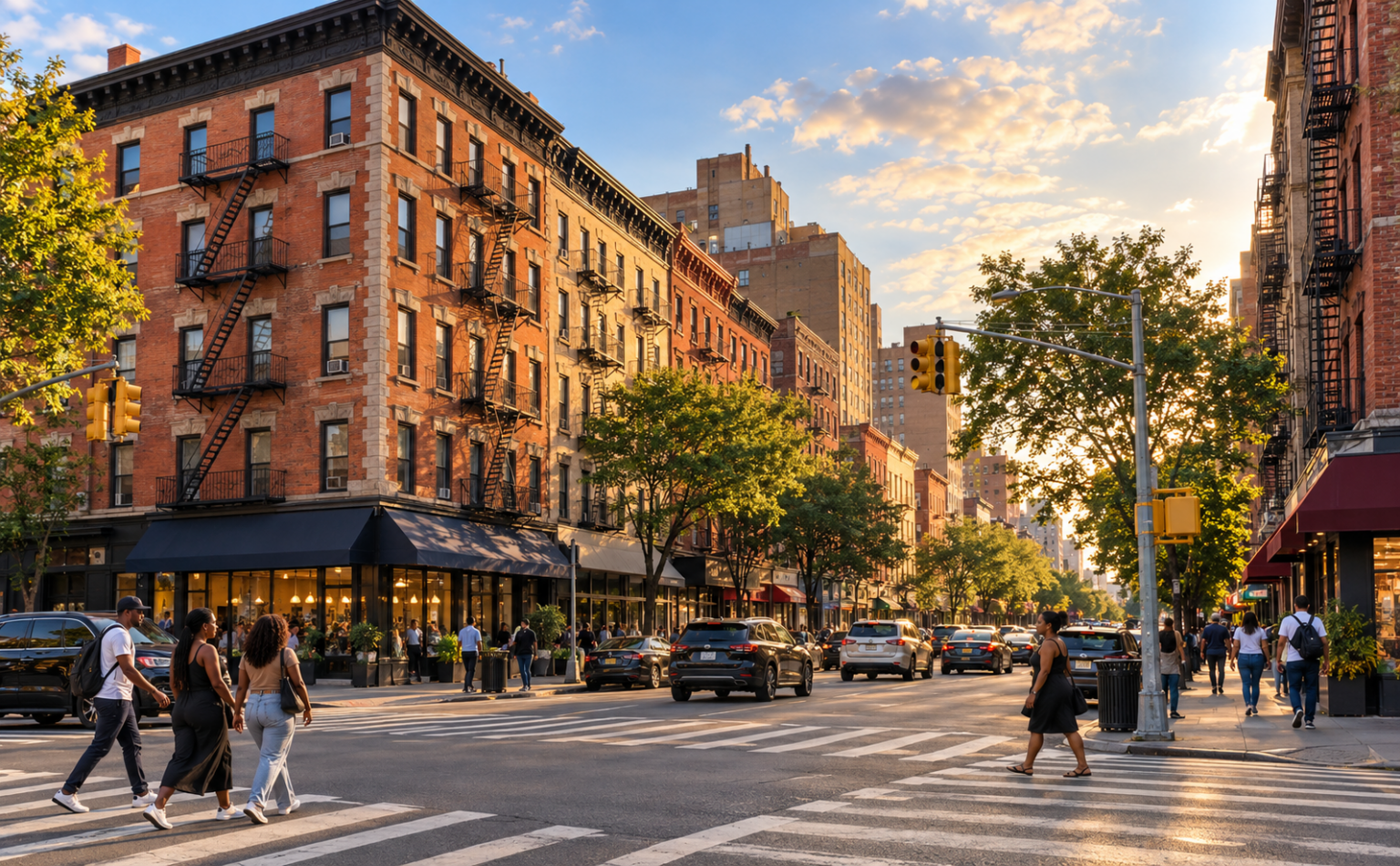
Most people who search for 145th and Lenox want one of three things: directions, food (usually Jimbo’s or fish), or the story behind the corner. Search results mostly give you map pins. This guide covers all three. It includes a dated timeline, the people and places that tie this intersection to Harlem history, and an honest look at what’s there now. Where a claim couldn’t be verified, we say so.
145th and Lenox at a Glance
The intersection of 145th Street and Lenox Avenue is in Central Harlem, near the top of Manhattan’s grid. Lenox Avenue officially runs from 110th Street to 147th Street, so 145th is one of its last major cross streets before the avenue meets the Harlem River Drive.
| Fact | Detail |
|---|---|
| Official street names | West 145th Street and Lenox Avenue / Malcolm X Boulevard (both names are legal and in use) |
| Neighborhood | Central Harlem, Manhattan Community Board 10 |
| Subway | 145th Street station, IRT Lenox Avenue Line (3 train), opened 1904 |
| Bridge | The 145th Street Bridge to the Bronx, opened 1905, sits a short walk east |
| Historic sites at or near the corner | Hotel Olga, Lenox Oval, the Dunbar Apartments, Harlem River Houses |
Why it matters: a subway terminal and a Harlem River bridge arrived within about a year of each other, and that pairing made this corner one of upper Manhattan’s main gateways. For the first half of the 20th century, Black Harlem’s hotels, ballfields and model housing grew up around it.
If you came for Jimbo’s, seafood or the park, skip to What Remains Today.
Origins and Historical Timeline of 145th Street and Lenox Avenue
We checked these dates against Wikipedia’s entries for Lenox Avenue and the IRT Lenox Avenue Line, the NYC Department of City Planning’s Malcolm X Boulevard report, and the Municipal Art Society’s 145th Street materials.
- 1887: Sixth Avenue north of Central Park is named Lenox Avenue after James Lenox, a philanthropist and book collector whose library later became part of the New York Public Library.
- Early 1900s: Builders put up row houses and apartment buildings along Lenox Avenue, betting on the coming subway. The overbuilding that followed is one reason landlords later opened Harlem to Black tenants.
- 1903–1904: The IRT Lenox Avenue branch is built. The 145th Street station opens on November 23, 1904, and for a short time it is the line’s northern end.
- 1905: The 145th Street Bridge opens across the Harlem River, connecting the street directly to the Bronx. Planners of the period expected 145th Street to become a major business street for upper Manhattan.
- 1910s: Lenox Oval, a ballfield at 145th Street and Lenox Avenue, hosts Black baseball, including the Lincoln Stars.
- 1920s–1940s: Hotel Olga operates at Lenox and 145th as one of the few first-class hotels open to Black travelers. Nearby, the Dunbar Apartments (1926–28) and Harlem River Houses (1937) go up.
- 1987: Lenox Avenue is co-named Malcolm X Boulevard. Both names stay in official use, which is why you see both on signs and in map apps.
- 2000s–present: City Planning studies the Malcolm X Boulevard corridor for zoning and streetscape changes. The 145th Street Bridge’s swing span is replaced in the mid-2000s.
One caution: you’ll find specific “firsts” for this corner online, such as the first Black-owned business or the first club. We couldn’t source them, so they aren’t in this timeline.
Notable People and Events at 145th and Lenox
Hotel Olga
Hotel Olga stood at Lenox Avenue and 145th Street. It was a luxury hotel for African Americans at a time when most Manhattan hotels turned Black guests away. Musicians, athletes and traveling professionals stayed there, and it is a regular stop on Harlem Renaissance walking tours, including the Municipal Art Society’s. Several popular accounts list famous guests. We left those names out because we couldn’t confirm them in primary sources.
Lenox Oval and the Lincoln Stars
Lenox Oval was an open-air ballpark at the corner. In the 1910s, before the Negro National League existed, it hosted Black professional and semi-pro baseball, including the Lincoln Stars. Harlem crowds could watch top Black players a few blocks from home, and the field also drew social clubs and Sunday crowds. Nothing of the original grounds survives.
The wider 145th Street circle
A few blocks away were some of Harlem’s most important residents. Paul Robeson, W.E.B. Du Bois and the explorer Matthew Henson all lived at the Dunbar Apartments on West 149th Street. The Odeon, a movie palace on West 145th Street, served the same crowds. For the musicians who made Harlem nightlife famous, see our history of Smalls Paradise. For the street-food business that grew up on Lenox Avenue a few blocks south, see our profile of Pigfoot Mary, the real Lillian Harris Dean.
Role in Harlem History
A transit gateway and crosstown corridor
Few Harlem corners have both a subway station and a bridge. The subway put downtown jobs within one commute, and the bridge carried traffic to and from the Bronx. As a result, 145th Street became a working commercial corridor rather than a quiet residential block. It still is: buses, the 3 train and bridge traffic all meet here.
Renaissance-era social life
The well-known Renaissance landmarks cluster around 125th and 135th Streets. 145th and Lenox was their northern anchor. It had the hotel where visitors stayed and the ballfield where neighbors spent weekends, and you can still walk between all of these sites in under 20 minutes.
Housing history
Two projects near the corner shaped how New York housed working families:
- Dunbar Apartments (1926–28): Financed by John D. Rockefeller Jr., this garden-apartment cooperative was built for Black residents. It’s a New York City landmark.
- Harlem River Houses (1937): Among the first federally funded public housing developments in the city. Its low-rise buildings and landscaped courtyards are still studied as a model.
The Malcolm X Boulevard corridor today
City Planning’s Malcolm X Boulevard report treats the avenue as one corridor, with attention to building heights, storefront activity and the boulevard’s wide median. It’s a dry read, but if you want to know why new buildings along the avenue look the way they do, the report is the authoritative source.
What Remains Today at 145th Street and Lenox
Don’t expect a museum corner. Most of what’s here is everyday Harlem: a subway entrance, bodegas, food counters, churches and apartment blocks. The history shows up in the street pattern and in the buildings nearby, not in plaques.
Getting there
- Subway: 3 train to 145th Street. The station’s platforms are short, so stay toward the middle of the train. The A, B, C and D at 145th Street/St. Nicholas Avenue are about a 10-minute walk west.
- Bus: Crosstown and Bronx-bound buses run on 145th Street. Check MTA’s trip planner for current routes.
- On foot: Lenox Avenue ends at 147th Street, two blocks north. The approach to the 145th Street Bridge is just east.
Jimbo’s on 145th and Lenox: what we could confirm
Many people search for “Jimbo’s 145th and Lenox,” but we couldn’t confirm a current Jimbo’s Hamburger Palace at that exact corner. The listings we found were at 528 W 145th St, near Amsterdam Avenue and about a mile west, and 284 Lenox Ave, near 124th Street. Directory sites contradict each other, and some are years out of date. Before you go, check Google Maps or call ahead.
Seafood and the 145th and Lenox fish market
Searches for “seafood on 145th and Lenox” and “145th and Lenox fish market” usually point to fried-fish counters and fish markets along 145th Street. We didn’t verify any one business at the corner itself, so we aren’t naming one. Fish spots in Harlem open, move and close often. Search “fish market near 145th St and Malcolm X Blvd” in a map app and sort by recent reviews.
The park on 145th and Lenox
Colonel Charles Young Playground runs along Malcolm X Boulevard just south of 145th Street. It’s named for the first Black U.S. Army colonel, and it’s the green space most people mean when they search for a park at the corner. Jackie Robinson Park, which has a pool and a recreation center, is roughly 10 minutes’ walk west between Edgecombe and Bradhurst Avenues. Check NYC Parks for current hours and pool season.
Keep exploring
If you’re walking the area, our guide to Harlem murals will help you find public art nearby. For summer street life along these avenues, see our coverage of the Harlem Block Party and Harlem Week.
Business details reflect our October 2026 research. Listings change, so confirm hours and addresses before you go.
FAQs
Is Lenox Avenue the same as Malcolm X Boulevard?
Yes. Lenox Avenue was named in 1887 for philanthropist James Lenox and was co-named Malcolm X Boulevard in 1987. Both names are official, so 145th and Lenox is also 145th Street and Malcolm X Boulevard.
What subway stops at 145th Street and Lenox Avenue?
The 3 train stops at the 145th Street station on the IRT Lenox Avenue Line, which opened on November 23, 1904. The A, B, C and D trains stop at 145th Street and St. Nicholas Avenue, about a 10-minute walk west.
What was Lenox Oval?
Lenox Oval was an open-air ballfield at 145th Street and Lenox Avenue. In the 1910s it hosted Black baseball teams, including the Lincoln Stars. None of the original grounds survive.
What was Hotel Olga in Harlem?
Hotel Olga was a luxury hotel at Lenox Avenue and 145th Street. It served African American travelers when most Manhattan hotels refused them, and it’s a regular stop on Harlem Renaissance walking tours.
Is there a Jimbo’s at 145th and Lenox?
We couldn’t confirm one at that exact corner. The Jimbo’s listings we found were at 528 W 145th St and 284 Lenox Ave (near 124th Street). Check a current map listing before you go.
Is there a park near 145th and Lenox?
Yes. Colonel Charles Young Playground runs along Malcolm X Boulevard just south of 145th Street. Jackie Robinson Park, which has a pool and recreation center, is about a 10-minute walk west.