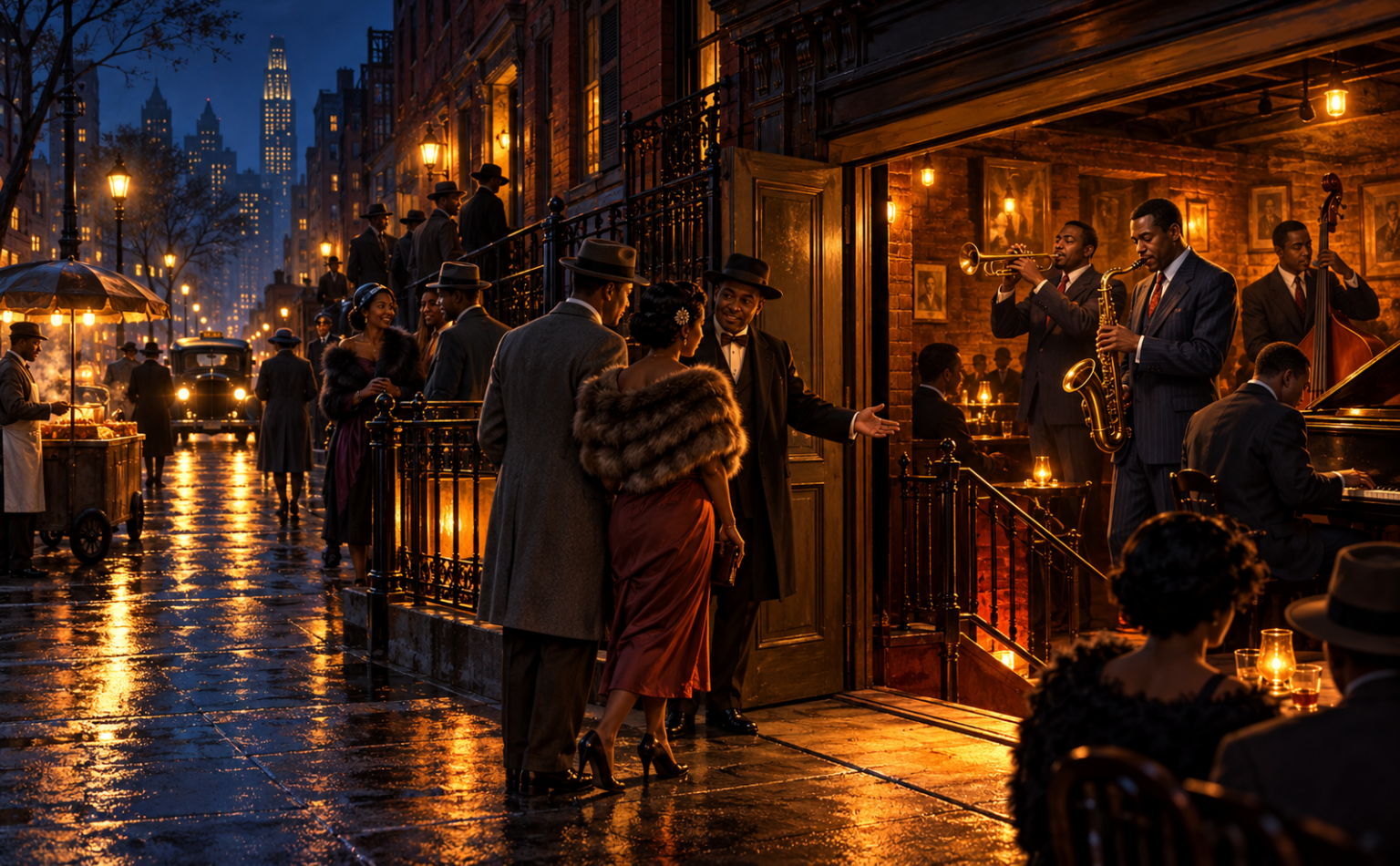
Swing Street is the nickname for West 52nd Street in Midtown Manhattan, mainly the block between Fifth and Sixth Avenues. From the mid-1930s to the late 1940s, small basement jazz clubs packed that block more tightly than anywhere else in the world. The best-known rooms were the Onyx, the Famous Door, Kelly’s Stable, the Three Deuces and the Downbeat. Billie Holiday, Art Tatum, Coleman Hawkins, Count Basie, Charlie Parker and Dizzy Gillespie all worked there.
There was also an earlier, uptown “Swing Street”: West 133rd Street in Harlem, between Lenox and Seventh Avenues. Locals called it Jungle Alley. It is where much of the 52nd Street talent first got paid. Two quick disambiguations: Swing 46 is a present-day jazz and supper club on West 46th Street, and Sing Street is an unrelated Broadway musical. Neither one is the historic Swing Street.
The Speakeasy Operators Who Built Swing Street
Harlem first: 133rd Street and the basement-club model
The business model behind Swing Street started uptown. During Prohibition, 133rd Street held a run of small cellar clubs: Pod’s and Jerry’s (also called the Log Cabin), Tillie’s Chicken Shack, Mexico’s, the Nest, and Monette Moore’s place. Rents were low, rooms were small, and the music often ran until dawn. These rooms did not make their money on big floor shows the way the Cotton Club did. They made it on liquor margins, food, and a pianist or singer who would work for tips and a small guarantee.
Talent scouts came from that circuit. In 1933, producer John Hammond heard a teenage Billie Holiday singing in a 133rd Street club, and the recordings he set up with her soon followed. Many of the pianists, singers and horn players who later filled the 52nd Street rooms had learned to hold a room on this block. For more on Harlem operators who turned small street-level businesses into real estate, see our profile of Pigfoot Mary, Harlem’s street-food entrepreneur turned landlord.
Midtown: Joe Helbock and the Onyx Club
The midtown version began with Joe Helbock. Around 1927 he ran the Onyx as a speakeasy at 35 West 52nd Street. Its regulars were mostly working musicians from the nearby radio studios, who came to drink and jam after their shifts. Prohibition ended on December 5, 1933. Helbock got a legal license, moved the club to 72 West 52nd in 1934, and started booking acts for the public instead of running a private hangout. A fire hit the Onyx in 1935 and it reopened. In 1936, Stuff Smith’s band had a hit there with “I’se a Muggin’,” which helped make the street famous outside the music business.
Other operators and why this block worked
The Famous Door opened in 1935 with backing from musicians and radio figures, and Louis Prima helped establish it early on. Kelly’s Stable, the Hickory House, Jimmy Ryan’s, the Three Deuces, the Spotlite and the Downbeat followed. Several of them changed addresses and names more than once.
Three things made a residential brownstone block work as a nightlife district:
- Cheap, ready-made space. Brownstone basements and parlor floors could become 60–100-seat rooms with little build-out. Many had already worked as speakeasies.
- A built-in audience. CBS and NBC studios, the Theatre District and Times Square hotels were all within walking distance. Musicians and stagehands finished work late and wanted somewhere to go.
- Clustering. With a dozen clubs on one block, customers could walk from room to room. Every club gained from foot traffic that no single club could have drawn alone.
Swing Street Timeline and Key Numbers
Sources disagree on several dates and addresses, because clubs moved, renamed and reopened. The table below gives the most widely supported version and notes where the sources differ.
| Year | Event | Source note |
|---|---|---|
| 1920s | 133rd Street (Jungle Alley) cellar clubs flourish in Harlem | Club names and addresses on this block are poorly documented |
| c. 1927 | Onyx runs as a speakeasy at 35 W 52nd under Joe Helbock | Some accounts give a slightly later start |
| Dec 1933 | Prohibition repealed; speakeasies can apply for licenses | Some pages say “1934 repeal”; the Onyx’s license and move date to 1934 |
| 1934 | Onyx moves to 72 W 52nd as a public club | A later Onyx operated at another 52nd Street address |
| 1935 | Onyx fire and reopening; Famous Door opens | Widely agreed |
| 1936–1939 | Peak swing era; Count Basie at the Famous Door (1938); Coleman Hawkins at Kelly’s Stable | Most sources count over a dozen active clubs |
| 1944–1946 | Bebop era: Parker and Gillespie at the Three Deuces and Onyx | Widely agreed |
| Late 1940s | Strip joints replace jazz rooms; police crackdowns | Most sources treat this as the effective end |
| 1962–1968 | The last jazz rooms close or move | Jimmy Ryan’s moved off 52nd in the early 1960s; the Hickory House, west of Sixth, is often cited as the last, closing in 1968 |
Two numbers come up again and again. One is “over a dozen clubs on one block.” The other is the claim that 52nd Street had more jazz clubs per block than anywhere on earth. Both are reasonable for roughly 1937–1946 but hard to check exactly. If you are citing figures for publication, check them against Arnold Shaw’s 52nd Street: The Street of Jazz (first published as The Street That Never Slept). It is the standard source.
Harlem and NYC Impact
Did Harlem musicians play on Swing Street?
Yes. Harlem supplied most of the street’s talent. Billie Holiday, Fats Waller, Count Basie, Dizzy Gillespie and many others lived or trained uptown and played sets in midtown. The money worked both ways. A 52nd Street engagement paid better and brought radio and press attention, while Harlem’s after-hours spots, later including Minton’s Playhouse on 118th Street, were where musicians developed new material. Bebop was largely worked out at Minton’s and Monroe’s in Harlem, then sold to a downtown audience on 52nd Street. For how Harlem performers of that period built national careers, see our story on Jules Bledsoe, from Waco to Harlem and Show Boat.
Was 52nd Street integrated?
Only partly. Some clubs were among the first in midtown to put Black and white musicians on the same bandstand, and the Hickory House and Famous Door are often mentioned for this. Audiences were another matter. Musicians’ memoirs describe Black customers being turned away or steered elsewhere, and military police and white patrons sometimes caused racial trouble during the war years. The street opened doors for Black musicians, but on midtown’s terms.
Why the 52nd Street scene declined
- Changing tenants. By the late 1940s, many owners found strip acts and B-girl clip joints more profitable than paying a quintet. The street’s reputation fell and police raids increased.
- The music moved. Bebop went to larger Broadway rooms such as the Royal Roost and Birdland (opened 1949) and to Greenwich Village, where audiences sat and listened instead of drinking at the bar.
- Real estate. The brownstones were worth more as development sites. Rockefeller Center’s expansion and corporate towers, including the CBS Building at 51 West 52nd (1965), replaced most of the block.
What Swing Street Means for Readers Today
Lessons for local entrepreneurs
We think Swing Street is one of the clearest small-business case studies in New York history, and it is useful to anyone opening a venue in Harlem today:
- Clustering beats isolation. Several competing rooms on one block drew more total customers than any one could have. Today’s restaurant rows and gallery corridors work the same way.
- Put yourself near your audience. The Onyx began by serving musicians from the radio studios down the street. Your first customers are usually the people who already work nearby.
- Licensing changes the business. Repeal turned speakeasy owners into licensed operators overnight. That opened them to the public but also brought rules and inspections. Plan for regulation, not around it.
- Tenants rarely control the endgame. Almost none of the club operators owned their buildings, so landlords and developers decided when the street was finished. If you can, aim for a long lease or ownership. Our coverage of 145th and Lenox shows the same pattern uptown.
Visiting Swing Street in New York, NY today
Expect office towers, not brownstones. Look for the “Swing Street” co-naming signs on West 52nd between Fifth and Sixth, and the sidewalk plaques honoring jazz musicians near the CBS Building. The townhouse at 21 West 52nd, home of the former ’21’ Club speakeasy, still stands with its row of jockey statues. It is the best surviving example of what the block once looked like. Allow about 20 minutes, then go uptown.
To hear live jazz, start in Harlem. Bill’s Place on West 133rd Street brings live jazz back to the old Jungle Alley block in a former speakeasy space. Minton’s Playhouse on West 118th is where bebop was born. In midtown, Swing 46 on West 46th offers swing bands and dancing, and the Village Vanguard and Smalls in Greenwich Village keep the small-room tradition going. Schedules and reservation rules change, so check each venue before you go. For more uptown culture you can see on foot, try our guide to Harlem murals.
FAQs
Why was 52nd Street called Swing Street?
In the 1930s and 1940s, West 52nd Street between Fifth and Sixth Avenues had more small jazz clubs per block than anywhere else, and swing was the music they played. Musicians, radio announcers and the press used the nickname, and the city later added it to street signs as an official co-name.
Where is Swing Street located in Manhattan?
Swing Street is West 52nd Street in Midtown, mainly between Fifth and Sixth Avenues, with a few clubs such as the Hickory House west of Sixth. In Harlem, West 133rd Street between Lenox and Seventh Avenues was an earlier uptown version, also known as Jungle Alley.
What clubs and musicians defined Swing Street?
The main clubs were the Onyx, the Famous Door, Kelly’s Stable, the Hickory House, Jimmy Ryan’s, the Three Deuces, the Spotlite and the Downbeat. Musicians who played there included Billie Holiday, Art Tatum, Coleman Hawkins, Count Basie, Stuff Smith, Charlie Parker and Dizzy Gillespie.
When did Swing Street end and why?
The jazz era effectively ended in the late 1940s, when strip clubs took over many of the rooms and bebop moved to bigger venues such as Birdland. The last jazz rooms closed or moved between the early 1960s and 1968, as office towers replaced the brownstones.
Is Swing Street the same as Swing 46?
No. Swing Street is the historic 52nd Street jazz block. Swing 46 is a present-day jazz and supper club on West 46th Street that books swing bands and dance nights. Sing Street is an unrelated stage musical.
Can you visit Swing Street today?
Yes, but almost none of the original clubs remain. You can see the Swing Street co-naming signs, jazz plaques near the CBS Building, and the former ’21’ Club townhouse at 21 West 52nd. For live jazz, go to Harlem venues such as Minton’s Playhouse or Bill’s Place on 133rd Street.